


It is well established that the UK has the highest proportion of inadequate housing in all of Europe. But what if the heart of the problem was worse than we thought?
To show the extent of the UK’s poor-quality housing, data was collected by the Home Builders Federation. To do this, they relied upon the Decent Homes Standard (DHS), formally introduced in 2001. The DHS was later updated to incorporate the Housing Health and Safety Rating System (HHSRS) in 2004. It has not been updated since then.
In 2023, the English Housing Survey posted the most up to date statistics on Housing Conditions in the UK. According to their survey, 10% of homes did not meet the DHS in the social rented sector (SRS), and 21% of homes did not meet the DHS in the private rented sector (PRS).
In 2024/25, there were 4.5 million socially rented homes, which means a staggering 450,000 homes do not meet the current standard. Bafflingly, the DHS does not currently apply to the PRS, despite 21% of homes in this sector are judged not to the standard.
Already a scandal, one indelible fact makes these statistics even worse – The DHS is declared not fit for purpose.
A failed metric for judging housing conditions
In January 2026, the government announced a new DHS. A month later, the Regulatory Policy Committee submitted an Impact Assessment on the proposed changes. It states that “the DHS should be updated to reflect modern expectations”, and that “the updated DHS should apply to the PRS”.
The government added further: “This will improve the quality of housing for millions of renters. It is a proportionate standard, prioritising safety, decency and warmth.”
The new DHS will completely overhaul the standard for the benefit of tenants. It includes removing age requirements of dwellings, and a new facilities requirement (including a kitchen, an appropriately located bathroom or toilet, and adequate external noise insulation). It will also include updated requirements in the Minimum Energy Efficiency Standard (MEES).
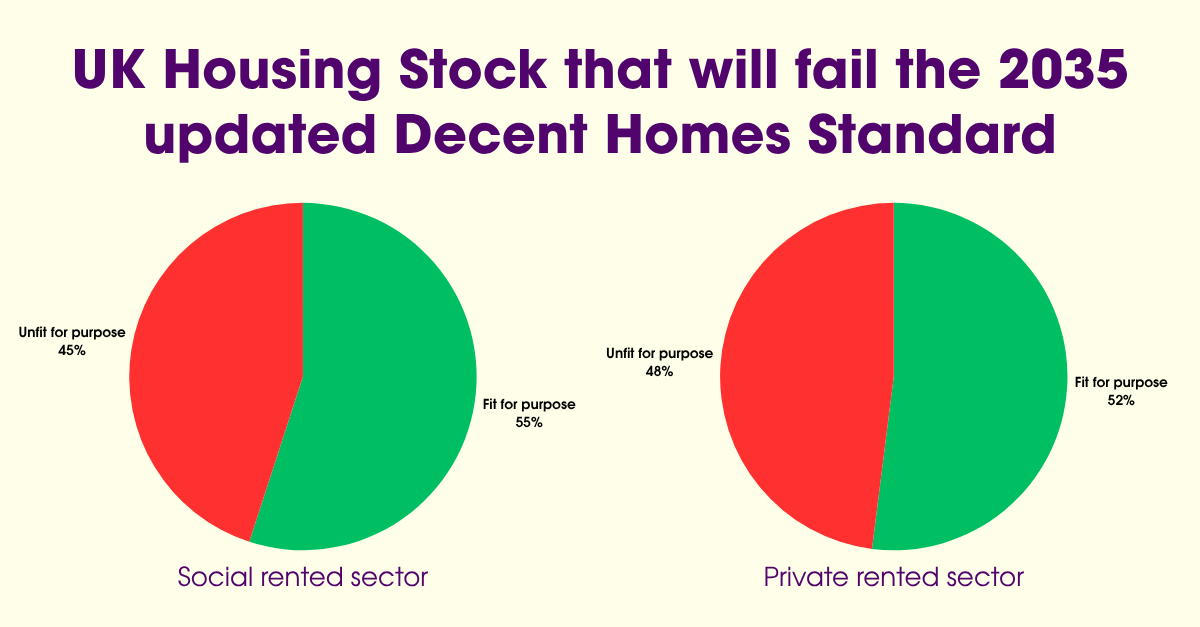
The Impact Assessment showed the expected impact of the changes, stating that if the new DHS applied to current housing stock, 45% of SRS homes, and 48% of PRS homes would fail the standard. An update is desperately needed.
However, the scandal worsens when you consider an even more indelible fact: the new DHS won’t apply until 2035.
A decade of uncertainty: Consequences of delaying the DHS
Described by Generation Rent as “absurd”, the new DHS will not apply to fit the updated standard for nearly a decade.
The government stated that “This timeframe has been chosen to allow landlords time to implement other regulatory changes, such as those introduced in the Renters’ Rights Act 2025, and to support the supply of new secure and affordable homes.”
They continued, “The 2026-2035 period is comparable to the ten-year target set for the first DHS, introduced in 2001, which required all social housing to meet set standards of decency by 2010”. But is this justification enough for the delays? What wider consequences to people’s health and livelihoods will be realised?
The all parliamentary group Households in Temporary Accommodation, discovered that between April 2019 and March 2025, 104 children died in temporary accommodation, which are subject to some of the worst housing conditions in the country.
Further, the Health Foundation showed that 71.8% of the lowest income households experienced one or more housing problems (compared with 37.2% in the second-lowest income quintile). Whilst the cost of living crisis worsens post-Covid-19, delaying the DHS will disproportionately affect the poorest in the UK.
The fact at hand is less indelible, more sinister: the decision to delay the DHS is a choice which prioritises landlords over tenants.
Tenants living with a DHS unfit for purpose
For the next nine years, tenants in the SRS will be living with a DHS not fit for purpose. Even worse, tenants in the PRS will be living without any DHS at all. This, ultimately, is a scandal which can’t be highlighted enough.
Peculiarly, enforcement mechanisms in the Renter’s Rights Act are reliant on a DHS which reflects the genuine poor conditions in people’s homes. The fragmentation of introducing the DHS retroactively will surely jeopardise the Renter’s Rights Act success in improving the quality of housing in the UK.
Time will tell whether the updated DHS has a significant impact on improving the UK’s housing conditions. For now, landlords will continue to profit from poor quality housing of which the government admits isn’t up to standard.
This is a scandal that should be shouted from the rooftops. 45% of SRS homes and 48% of PRS homes will not respectively meet the updated DHS. Unless something changes, renters around the UK will have to endure these conditions until 2035 at least.
This article was first featured in Legal Futures in June 2026.
Jacob Poole is a Housing Operations Coordinator at Pabla + Pabla Solicitors. Aside from managing Housing Disrepair claims, he is a writer and researcher and has a particular interest in helping alleviate the UK’s ongoing UK housing crisis.

More on Housing Disrepair:



Author Christian Potter View all posts

Author Jacob Poole View all posts


Author James Bosson View all posts


Author Jacob Poole View all posts

Author Jacob Poole View all posts

Author Jacob Poole View all posts
Author Jacob Poole View all posts

Author Jacob Poole View all posts
Author Jacob Poole View all posts









Author Sean Radford View all posts
Author Jacob Poole View all posts