


Associate Partner and Head of OIC, Germann Reinberg, secured an incredible settlement for a client badly harmed in a work accident – and settled their claim for £140,000.
The client, Mr O, was working as an HGV Driver for a skip hire and industrial waste company, when several heavy metal installation coils fell out of the back of his lorry as he was unloading. His shins were crushed, and his life changed instantly.
Mr O was in hospital for weeks, undergoing an enormous amount of surgical treatment for his injuries. During his stay, he contacted Pabla + Pabla Solicitors and instructed us to begin acting for him on an Employer’s Liability Personal Injury claim. Here’s how the case unfolded.
How was Mr O injured?
Mr O was employed by a skip hire and industrial waste company. He was widely regarded as a competent and reliable driver, and even held a higher category HGV that allowed him to drive larger vehicles. He enjoyed his work a lot. He especially enjoyed the higher earnings and prestige amongst his peers that came with driving heavier-class articulated lorries. Outside of work, he enjoyed a fairly active lifestyle.
It was April, and Mr O had just parked his lorry in his employer’s vehicle yard. It was a breezy but clear day in early spring, and summer was just around the corner. Mr O got out of his lorry and waved at his colleagues in the yard. He walked around to the back to begin unloading. The lorry had an open top, and had been loaded by crane with several large metal installation coils.
All HGV drivers know that the back doors of lorries should be regularly greased to ensure they open fluidly. Mr O found that the back door of this particular lorry had not been greased for some time, and was very stiff. He pushed harder, but the door was stubborn and didn’t budge. He dug his feet in and pushed much harder, and the door suddenly cracked open.

The heavy coils inside had not been secured, and as soon as the door opened they fell out and came tumbling towards Mr O. The first coil struck him in the head, disorientating him and knocking him to the ground. He began to turn and crawl away, but more coils fell. They landed on his shins – completely crushing them.
The pain was immense. Mr O cried out in pain for his colleagues in the yard. They starting running over to him, and Mr O lost consciousness.
How was Mr O treated for his injuries?
When Mr O came around he was already in hospital. He was lying in bed and his legs were encased in metal cages. In the weeks that followed, Mr O underwent several large operations to try and save the use of his legs. The dead / damaged musculature in his lower limbs had to be cut out surgically. Metal rods had to be screwed into the hollow canals of his leg bones to support them. Muscle, bone, and skin grafts were all conducted to try and repair as much of the damage as possible. Between surgeries, Mr O took huge volumes of painkillers to cope.
Aside from the physical injuries, Mr O also struggled psychologically during his time in hospital. He found his thoughts going round and round in circles about the accident, and had nightmares almost every time he slept. On multiple occasions he saw someone opening large doors in the hospital and experienced vivid, painful flashbacks to the accident. It was in this state, still in the hospital, that he contacted Pabla + Pabla for the first time – and his case was assigned to Germann.
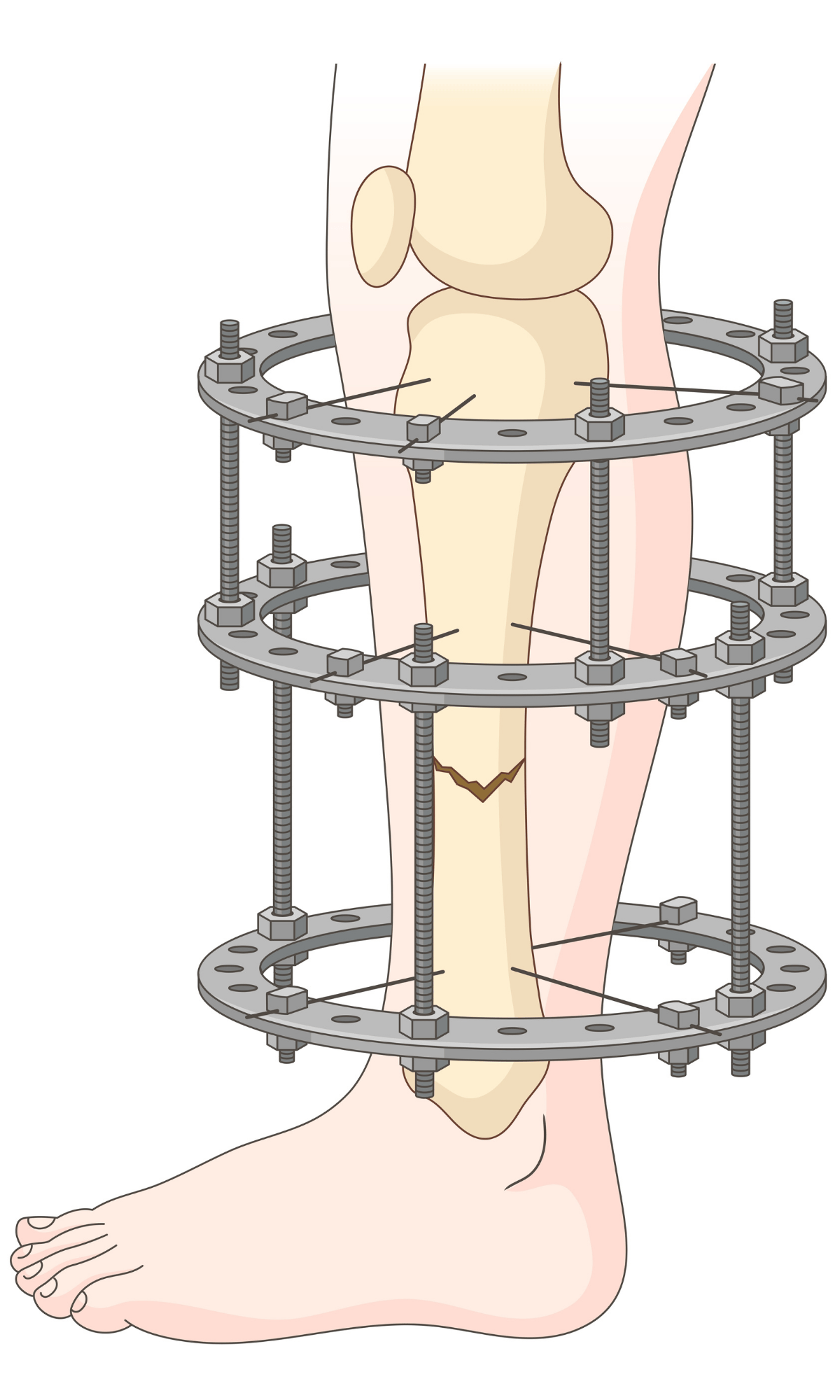
Five weeks later, Mr O’s operations were complete and was discharged from hospital. His right leg was fitted with an Ilizarov apparatus for support and he was bound to a wheelchair. His sister agreed to take him in, and he moved into her front room to recover. Mr O’s sister provided him with a near constant level of support – feeding him, bathing him, as well as cleaning and dressing his wounds. She took him to follow-up appointments with medical experts, and did everything she could to look after him.
After two months, Mr O was semi-mobilized with crutches, and he began to regain small amounts of independence. He could move about, albeit very painfully. He struggled a lot psychologically, and was troubled by the excessive scarring on his legs and loss of his active lifestyle. He persevered, however, and kept attending his medical appointments and physiotherapy sessions. After four months, he slowly began to walk without the crutches and returned to his own home. It wasn’t easy, and he struggled with basic domestic tasks such as cooking, cleaning, and washing. Eleven months after the accident, the metal apparatus on his right leg was finally removed and he could begin more strenuous rehab work.
Eventually, Mr O was able to gradually return to work on a part-time basis – though his injuries meant he could no longer drive the larger, heavier lorries he previously took a great deal of pride in. He will be physically scarred for the rest of his life and will almost certainly develop arthritis in the years to come.
How did Germann handle the Employer’s Liability claim?
Whilst Mr O was recovering, Germann was busy working on his case. He spent months obtaining medical records, recording witness statements, having extensive phone conversations with Mr O, and even educating himself on how to properly load and unload an HGV. Slowly, he built a full picture of the accident, what caused it, and what the long-term health implications would be.
As part of his process, Germann consulted with an expert barrister and an independent medical practitioner, building up specialist opinions on Mr O’s medical situation and legal options. This helped to legally classify Mr O’s injuries, but also understand what the approximate value of the claim would be. Ultimately, Germann concluded that the injuries would be classed as “serious” by the Judicial College, which valued the claim at £47,840 – 66,920.

“Serious compound or comminuted fractures or injuries to joints or ligaments resulting in instability, prolonged treatment, a lengthy period of non-weight-bearing, the near certainty that arthritis will ensue; extensive scarring. To justify an award within this bracket a combination of such features will generally be necessary.”
On top of this, Germann also considered a number of other factors when valuing the claim. The fact that Mr O had lost earnings whilst he was recovering and unable to work. The fact that Mr O had missed out on potential pension contributions. The fact that Mr O’s sister had supported him during his recovery – essentially doing the work of a full-time carer. Crucially, Germann decided to push for “Smith V Manchester” compensation as part of the claim.

Smith V Manchester is a very specific payment that can be legally sought in Personal Injury cases. It is compensation for a potential loss of future earnings, when someone is injured at work and would be “disadvantaged on the open labour market”. In Mr O’s case, his injury meant he had lost the ability to drive larger lorries and would have to drive smaller categories of vehicles. This would likely impact his future career prospects, Germann decided to argue.
One evening, Germann called Mr O to present the case he had spent months building, and discuss the potential value of the claim. Taking all of his findings into consideration, Germann valued the claim at £130,000 with the potential to reach £165,000 given the complexity of Mr O’s injuries and uncertainty of his medical prognosis. It was time to open negotiations.
How did Mr O’s case settle?
Germann submit a Letter of Claim and a Schedule of Loss to Mr O’s employer. This is a formal notice of the claim, its value, and a comprehensive breakdown of how that valuation was reached.
What followed was the age-old delicate dance of two competing legal representatives. Mr O’s employer appointed a defense solicitor to represent them in the negotiations, and Germann went back and forth with them extensively. They discussed the finer details of Mr O’s medical reports, his future employment prospects, and the other details Germann had laid out in the claim value.
Legal negotiations in Personal Injury cases are fascinating to witness from an outside perspective. There is a remarkable degree of nuance to positioning arguments within wider legal frameworks, and carefully selecting language in written correspondence with the “other side”. Defense solicitors work hard to open up flaws in the “pleaded case”. It is the claimant solicitor’s job to work even harder to counter them. It is always a time-intensive and challenging process that Germann personally finds great enjoyment in.
Eventually, Germann was able to secure a hard-won liability admission, and the defense solicitor accepted responsibility for the accident. Alongside this, the defense made an initial settlement offer of £40,000. German responded stating that this was “grossly inadequate for the nature of the injuries and the uncertainty of the losses suffered”. After some more legal back and forth, Germann managed to settle the case for £140,000. Germann spoke with Mr O on the phone, and he said he was happy to accept the offer. The full negotiation process had taken three months.

The case closed, and Germann had not only achieved a very strong outcome, but had managed to cover all of his costs in the damages obtained from the defendant. This meant that Mr O received his settlement amount in full.
Mr O and Germann had their final phone conversation on a cold November evening, some three years after the accident. The two reflected on the case finally concluding, and Mr O’s ongoing recovery. Whilst his injuries would likely never fully recover to a pre-accident level, he was very pleased to recovering well given the circumstances. He thanked Germann, and said he planned to use the money to buy a house.
“Your approach to any case has to be the exact same, regardless of value. The level of attention you offer is always the same for every client. The most satisfying part of this job is when you help someone by achieving more than they ever thought would ever be possible. It’s all about knowing the relevant caselaw and how to position cases to achieve a good outcome”
– Germann Reinberg
BEGIN YOUR WORKPLACE INJURY CLAIM
Our team of legal experts successfully represent hundreds of claimants every single year. Let them win the justice you deserve.More real stories:

Author Sean Radford View all posts

Author Jacob Poole View all posts


Author Jacob Poole View all posts

Author Jacob Poole View all posts

Author Karen Booth View all posts










Author Sean Radford View all posts
